
AI Agent for Business is no longer an advanced technical option; it has become a necessity for any company seeking rapid growth and improved customer experience. Today, businesses that rely on an AI Agent for Business can respond instantly to customers, categorize and qualify them before they reach the sales team, increasing conversion rates while reducing operational pressure.
However, there is a significant difference between a simple chatbot that sends predefined responses and an AI bot capable of understanding, analyzing, and making decisions within the context of a conversation. Whether the goal is to build a WhatsApp chatbot for customer support or an AI sales agent that collects data and qualifies potential customers, the right design determines the results.
In this practical guide, we will explain the steps to build the system professionally, starting from defining roles and responsibilities, moving through structure and memory, and ending with integration into communication channels and CRM systems. The goal is not just to build a tool, but to support digital transformation for companies in a strategic way that drives real, scalable growth.
Why Do Businesses Need an AI Agent Today?
Fast response time is no longer an added advantage; it has become a decisive factor in the buying decision. Customers today communicate through WhatsApp, websites, and social media expecting immediate and clear answers. Any delay may push them directly to a faster competitor. This is where an AI Agent for Business becomes a practical solution, ensuring your company remains available 24/7 and transforming conversations from simple incoming messages into real opportunities that can be leveraged intelligently.

Impact on Sales
When you rely on an AI sales agent, you are not simply using a chatbot to reply. You are building a system that qualifies customers and guides them toward the right decision. It asks the right questions, collects essential data, analyzes customer intent, and directs the conversation toward booking, purchasing, or transferring directly to a sales representative within your CRM. This increases conversion rates by reducing early-stage drop-offs and allowing your sales team to begin with well-qualified prospects instead of general inquiries.
Reducing Hiring and Support Costs
Many companies experience increasing pressure due to a growing number of daily messages, and the traditional solution is hiring more employees. However, this leads to higher payroll costs, ongoing training, and inconsistent response quality. Using a professionally designed AI bot or WhatsApp chatbot reduces this burden by handling repetitive questions, categorizing requests, and routing them accurately. The result is a more focused support team, lower operational costs, and consistent service quality.
Its Role in Digital Transformation for Companies
Digital transformation does not simply mean using modern tools; it means redesigning how work is done. A professional AI Agent becomes a smart connection point between conversations and internal systems, converting each message into structured data, linking it to a CRM system, and automatically creating deals or support tickets. This transforms inbox chaos into a measurable and optimizable process, giving management clearer insights and faster decisions based on real data.
What Is an AI Agent for Business?
An AI Agent for Business is not just a WhatsApp bot that sends predefined responses. It is an intelligent system capable of understanding conversation context, analyzing customer intent, and taking the appropriate action at the right moment. It can qualify leads, collect customer data, categorize them inside a CRM, or transfer conversations directly to sales or support departments. Its primary purpose is to transform every interaction into a measurable and optimizable opportunity instead of leaving messages as simple inquiries.
The Difference Between a Traditional Chatbot and an AI Agent
A traditional chatbot operates on a fixed script based on predefined buttons and options. When users step outside that flow, it stops working effectively or provides irrelevant responses. A professional AI Agent, on the other hand, relies on understanding, analysis, and learning from data, enabling it to handle diverse questions in different formats. The former simply answers, while the latter qualifies, categorizes, and makes decisions aligned with business objectives.
Practical Steps to Build a Professional AI Agent
After understanding the importance of an AI Agent for Business and the difference between it and a traditional chatbot, we now move to the practical side. Building an effective system is not about installing a tool, but about following structured steps that begin with planning and continue with continuous optimization. In the following sections, we will explore the key phases required to launch an AI Agent capable of supporting sales and driving digital transformation for companies.
Start building your AI Agent today
Define the Agent’s Goal Clearly
Before building an AI Agent, its role within the company must be clearly defined. Is the goal customer support and answering frequent questions? Qualifying leads and converting them into sales opportunities? Or operating a WhatsApp chatbot for orders and bookings? Clear objectives determine the system architecture, the type of data collected, and the integration approach with CRM systems, directly influencing final outcomes.
Design the Conversation Structure and Internal Logic
The conversation structure is the operational brain of the AI Agent. At this stage, you define how messages are received, analyzed, responded to, and stored. Classification rules are established, conversion points to the sales team are identified, and objection-handling strategies are set. The more organized and well-planned the internal logic, the smoother and more professional the performance of your chatbot or AI bot.
Add Memory and Connect the System to a Knowledge Base
A professional AI Agent requires real memory built on your company’s data. Whether through RAG techniques or integration with an internal knowledge base, the objective is to ensure responses are grounded in accurate information about your services, pricing, and workflows. Without a clear knowledge base, the system becomes a generic chatbot that does not reflect your brand identity. When properly connected to real data, it becomes a powerful tool supporting digital transformation and building customer trust.
Integration with CRM Systems and Communication Channels
The real value appears when integrating the AI Agent with CRM systems and communication channels such as WhatsApp and your website. At this point, it transforms from a simple AI bot into a centralized tool that manages data and conversations in one place. For example, when integrated with a system like Bitrix24, it can automatically create a new contact, open a deal within the sales pipeline, update the pipeline stage, and instantly notify the sales representative when a qualified lead is available. This turns conversations into a structured and measurable sales process instead of scattered inbox messages.
Testing and Continuous Optimization
After launching the AI Agent, the most important phase begins: continuous optimization. This includes analyzing conversations, measuring conversion rates, reviewing response quality, and refining workflows when necessary. A successful system is not a one-time setup; it is an ongoing development process that ensures performance remains aligned with sales objectives and customer experience.
Advanced Intelligence: Memory and Knowledge Base
The strength of a professional AI Agent does not rely solely on its ability to understand messages, but on the quality of knowledge it uses to generate responses. Memory and a structured knowledge base transform a simple chatbot into an intelligent system that accurately reflects your brand identity. When information is well organized and includes detailed services, pricing, and workflows, the AI Agent can deliver accurate responses that support sales and strengthen customer trust.
The Difference Between Generic Responses and Company-Based Responses
A generic response relies on broad training data that may be theoretically correct but does not represent your company’s reality. A company-based response, however, is built on a customized knowledge base containing your service details, policies, current offers, and actual execution processes. This is where an AI sales agent evolves from a simple response tool into a digital consultant capable of confidently guiding customers toward the right decision without misinformation or confusion.
Building a Knowledge Base
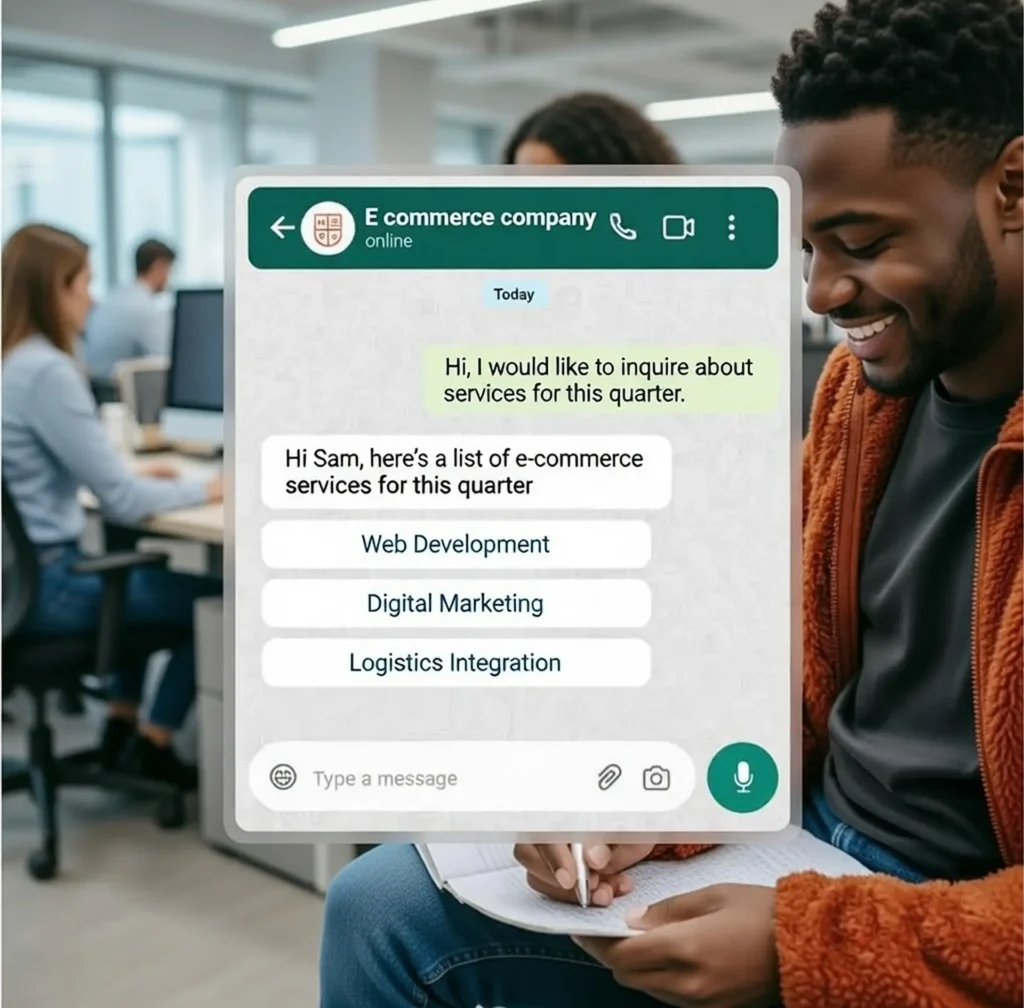
Creating a professional knowledge base begins by collecting frequently asked questions, detailing services or products, defining workflows, and clarifying payment and support policies. This information is organized clearly within documentation or a knowledge management system, then connected to the AI Agent to be used during conversations. The more structured and updated the data is, the more accurate and stable your AI bot will perform, especially when handling diverse inquiries via WhatsApp or your website.
Updating Knowledge Regularly
Information within any company changes continuously, whether in pricing, offers, or execution processes. Therefore, it is essential to review and update the knowledge base regularly to ensure the AI Agent always provides accurate information. Neglecting updates can result in outdated or incorrect responses, which negatively impacts credibility and weakens the customer experience, particularly when the goal is to support digital transformation in a sustainable and professional manner.
The Role of respond.io in Training a Customized AI Chat Agent Easily
The respond.io platform provides a practical environment for training a customized AI chat agent and connecting it with communication channels such as WhatsApp and your website. Through knowledge management tools and CRM integrations, you can build a professional WhatsApp bot that relies on your company’s real data and operates within a structured framework. This makes the launch process easier and faster while allowing continuous scaling and improvement according to business needs.
Common Mistakes When Building an AI Agent
Building an AI Agent for Business may seem simple at first, but many companies make mistakes that reduce effectiveness and negatively affect customer experience. The issue is rarely the technology itself, but rather the design and implementation approach. Avoiding common mistakes from the start saves time and cost while ensuring that your chatbot or WhatsApp bot functions as a real sales and support asset.
Relying on a Fixed Script
One of the most common mistakes is building the system on a closed script with predefined questions and answers only. While this approach may work for simple cases, it fails when users ask questions outside the expected framework. A professional AI Agent must understand customer intent and handle diverse inquiries rather than restricting users to limited options that make the interaction feel mechanical.

Lack of a Clear Knowledge Base
When there is no structured knowledge base, the AI bot relies on generic information or random responses, resulting in inaccurate answers. Without your company’s actual data, an AI sales agent cannot provide reliable information about services, pricing, or workflows. This weakens trust and directly impacts conversion rates.
Launching Without Proper Testing
Launching the system without internal testing and scenario simulation can lead to embarrassing errors in front of customers. It is essential to test conversation flows, response accuracy, human handover processes, and CRM integration before going live. Testing is not an optional step; it is a critical phase to ensure that your AI Agent reflects a professional company image.
Why Do I Write About AI Agents?
I specialize in digital transformation for companies and have spent years designing CRM systems and automating sales and customer support processes. Through my work with businesses across different industries, I have helped sales teams transition from manual, scattered responses to intelligent systems powered by chatbots and AI bots capable of handling customers professionally. My experience with systems such as Bitrix24 and Kommo, along with my role as an official partner of a leading conversation management platform, has given me practical insight into building AI Agents for Business the right way to achieve real results.
Start Now and Try respond.io in Practice
If you are serious about building an AI Agent for Business and transforming conversations into real sales opportunities, the next step is simple: start with hands-on experience. Registering on the platform provides you with a ready environment to connect a WhatsApp bot, manage conversations, and train an AI bot based on your company’s real data. Practical experience will give you deeper insight into how the system can increase conversion rates while reducing time and operational costs.
Try respond.io and Build Your First AI Workflow
How I Can Help You as an Official Partner and CRM Specialist
In addition to registration, you can benefit from my expertise in digital transformation and CRM system design such as Bitrix24 and Kommo to build a fully integrated solution tailored to your specific business. As an official partner of the platform, I assist with account setup, AI Agent training, building a structured knowledge base, and integrating it properly with CRM and sales pipelines from the start. The goal is not simply to launch a tool, but to design a scalable, intelligent sales system that supports your company’s long-term growth.